Balcony repair on high-rise buildings: what to expect
Why concrete balconies deteriorate, the warning signs to watch for, what a repair program includes and how residents stay safe during the work.
On this page
Concrete balconies are among the most exposed parts of a high-rise. They take weather on the top, the bottom and the edges, and a hairline crack or a failed sealant can turn into falling concrete if it is left alone. This guide explains why balconies deteriorate, what to watch for and what a repair program looks like.
Why concrete balconies deteriorate
A balcony is a concrete slab with steel reinforcing inside, open to the weather on every side. Three things wear it down:
- Water. Rain and snowmelt sit on a slab that does not drain well, and soak in through cracks, worn coatings and failed sealants.
- Freeze-thaw. Water inside the concrete freezes and expands. Winter after winter, that breaks down the surface and widens cracks.
- Corroding rebar. Concrete normally protects the steel inside it. Over time, salt and a slow reaction with the air called carbonation can wear that protection away. Then water and oxygen let the steel rust, and because rust takes up more room than steel, it cracks the concrete from the inside.
Slab edges and railing posts are common trouble spots. The concrete over the steel can be thin at the edges, and the pockets where railing posts are set into the slab can let water straight in.
De-icing salt used on balconies in winter speeds up the damage, so it is worth asking residents not to use it.
Warning signs residents and managers notice
Residents are often the first to spot a problem, so it helps to tell them what to report:
- Cracks in the slab, along the edge or on the underside, called the soffit
- Rust stains or brown streaks on the slab edge or soffit
- Concrete that sounds hollow, is crumbling or has broken off, especially at the edges
- Exposed rebar
- Loose or wobbly railings, or cracked concrete around railing posts
- Water ponding on the balcony, or draining back to the building instead of away from it
- Peeling or bubbling coatings, and white staining on the underside
- Failed caulking where the balcony meets the wall, or water getting in at the balcony door
Some of these are cosmetic and some are not. A loose railing, falling concrete or exposed steel at a slab edge should be treated as urgent. Keep people off the balcony, protect the area below and have it reviewed right away.
What a balcony repair program includes
A balcony program usually starts with an engineer’s review of the balconies and a set of drawings and specifications for the repairs. Not every balcony needs the same work, and the full extent of the damage is often only clear once the concrete is opened up.
The work usually includes:
- Slab and edge concrete repairs. Damaged concrete on the top surface, the slab edge and the underside is removed, the steel is cleaned or replaced, and the area is rebuilt.
- Waterproofing coating. A waterproof coating on the walking surface keeps water and salt out of the slab.
- Sealants. New sealant where the balcony meets the wall, at door thresholds, around railing posts and at other joints.
- Railing work. Railings may be removed and reinstalled, repaired or replaced, with the post connections fixed so water stops getting into the slab.
- Painting. Slab edges and soffits are coated or painted to protect them and give the building a consistent finish.
For more on how damaged concrete is removed and rebuilt, see our concrete repair page.
Since the access equipment is already in place, it can also make sense to repair precast and other facade elements at the same time.
Access from swing stages and scaffolding
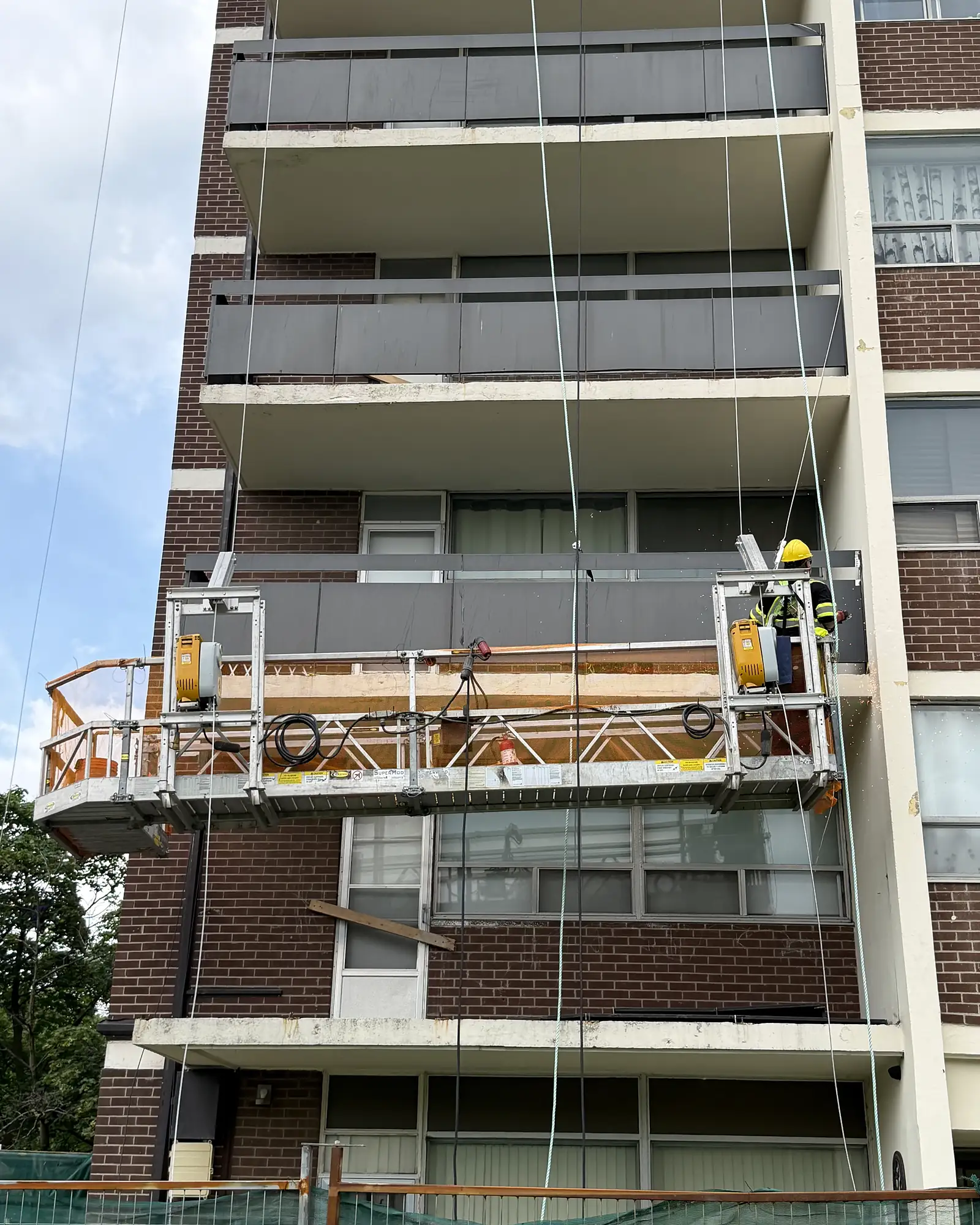
Repairs to slab edges and undersides need access from outside the building. On a high-rise, that usually means swing stages, scaffolding or both.
Swing stages are work platforms hung from the roof on cables. The crew works one vertical line of balconies at a time, called a drop, then the stage is moved to the next drop. They can reach every floor without building a structure up the face of the building.
Scaffolding is built up from the ground or a lower roof. It suits lower floors, podium levels and areas a swing stage cannot reach, and it stays in place while the work in that area is underway.
The right mix depends on the building height, the shape of the facade, the roof and the space at ground level. Setting up suspended access takes planning: roof access, anchor points, protection at ground level and a crew trained for work at heights.
FDS runs a COR-certified safety program through IHSA. Our crews have worked from both swing stages and scaffolding, including on a high-rise balcony and precast restoration in March 2024.
Keeping residents informed and safe
Balcony work happens right outside people’s homes, so communication matters as much as the concrete. Residents should know:
- When work will reach their balcony, with enough notice to clear it of furniture, plants, barbecues and storage
- That the balcony is off-limits while work is underway and until new coatings have cured
- To keep balcony doors closed and locked during work, and to expect workers outside their windows
- When noisy work, such as chipping concrete, is planned
- Who to contact with questions or concerns
At ground level, the area below the work is protected with barriers, covered walkways or closed-off zones. A building entrance below the work may need overhead protection or a temporary route.
A good contractor keeps the property manager updated on progress, schedule changes and weather delays, so the building can pass clear information on to residents. At FDS, we phase the work around residents and budget.
Talk to FDS
FDS has been restoring Ontario buildings since 2018, with 50+ team members and our own crews. If your balconies show cracks, rust stains or spalling, book a free site visit. The site visit and the written quote are free, with no obligation.
We work in four steps: Assess, Plan, Restore, Deliver. Learn more on our balcony restoration page, or call us at (416) 742-3683, Monday to Friday, 8 a.m. to 5 p.m.
Want us to look at your building?
We visit, take photos and send you a written quote with a clear scope and price. The visit is free, with no obligation.